
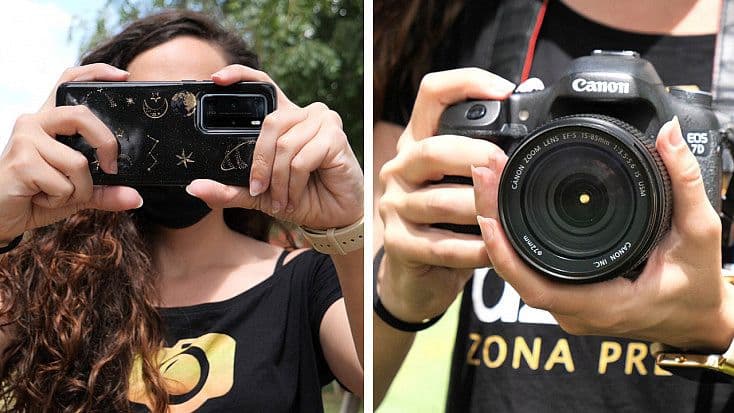
Dominican Republic. — The evolution of cameras built into mobile phones has transformed the way people capture and share images. Mobile devices now offer photographic quality that, under certain conditions, can produce surprising results. However, when it comes to professional photography, there are factors that go far beyond megapixel count.
The main difference between a photo taken with a phone and one taken by a professional lies in the creative process behind the image. Lighting, composition, direction, lens choice, camera handling, knowledge of the environment, and editing are some of the elements that determine the final result.
For everyday photography, a phone can be a practical and sufficient tool. However, in areas such as corporate photography, advertising, products, professional portraits, events, and brand content creation, planning becomes fundamentally important.
A professional photographer doesn't just capture an image. They also analyze how to use light, which angle favors the subject, how to build the composition, and which elements should appear or disappear from the frame to convey a particular message.
Lighting is one of the aspects that can most transform a photograph. While a phone relies mainly on available conditions and its computational processing, a photographer can use different light sources and modifiers to control shadows, contrast, volume, and depth.
Another important element is direction. In a professional session, the photographer can guide the model on body position, expression, gaze, and posture to achieve a more natural image that's consistent with the purpose of the session.
Mobile technology keeps advancing and offering more possibilities. However, this doesn't diminish the importance of the knowledge and experience behind a photographic production.
For companies and professionals who use images as part of their brand identity, photography stops being just a record and becomes a communication tool.
The conclusion can be simple: a phone can have an excellent camera, but professional photography begins long before pressing the shutter button.
The difference isn't only in the equipment used, but in knowing how to turn an idea into an image capable of communicating, building trust, and conveying an identity.
Romero Group Team
Visual production · Santo Domingo, DR
Photography, video, drone, and live experiences for brands that want to stand out. We write about what we learn in every production.